GLM LLM Models
GLM is a cutting-edge LLM series by Z.ai (Zhipu AI) featuring GLM-5, GLM-4.7, and GLM-4.6. Engineered for complex systems and long-horizon agentic tasks, GLM-5 outperforms top-tier closed-source models in elite benchmarks like Humanity’s Last Exam and BrowseComp. While GLM-4.7 specializes in reasoning, coding, and real-world intelligent agents, the entire GLM suite is fast, smart, and reliable, making it the ultimate tool for building websites, analyzing data, and delivering instant, high-quality answers for any professional workflow.
Explore the Leading GLM LLM Models
Atlas Cloud provides you with the latest industry-leading creative models.

What Makes GLM LLM Models Stand Out
Atlas Cloud provides you with the latest industry-leading creative models.

Advanced Reasoning
Tuned for strong logical reasoning, structured analysis, and multi-step problem solving.

Cost-Efficiency
Optimized architectures keep latency and costs under control.

Safety & Governance
Built-in content filters, auditing tools, and policy controls help teams deploy.

Enterprise Reliability
Production-ready SLAs, monitoring, and governance features help teams confidently ship applications.

Chinese–English Excellence
Native-strength Chinese and fluent English support enable high-quality bilingual chat, search, and generation.

Developer-Friendly Ecosystem
Clean APIs, SDKs, and tooling make it easy to integrate, fine-tune, and operate Z.ai across products and platforms.
Peak speed
Lowest cost
| Model | Description |
|---|---|
| GLM-5 | GLM-5 is Z.ai's flagship LLM featuring a massive 202.75K context window optimized for complex systems and long-horizon agentic tasks. Outperforming elite closed-source models in benchmarks like Humanity’s Last Exam and BrowseComp, it provides robust programming and stable multi-step reasoning at highly competitive baseline pricing. |
| GLM-4.7 | GLM-4.7 is a high-performance LLM with a 202.75K context window specifically engineered for real-world intelligent agents, advanced reasoning, and professional coding. Fast, smart, and reliable, it serves as the ideal engine for building complex websites and automating sophisticated professional workflows with precision. |
| GLM-4.6 | GLM-4.6 is a powerful MoE LLM with a 202.75K context window designed for rapid data analysis and instant, high-fidelity answers. This dependable model excels at high-efficiency tasks like creating professional slides and web content, offering a smart balance of speed and enterprise-grade performance. |
New features of GLM LLM Models + Showcase
Combining advanced models with Atlas Cloud's GPU-accelerated platform delivers unmatched speed, scalability, and creative control for image and video generation.
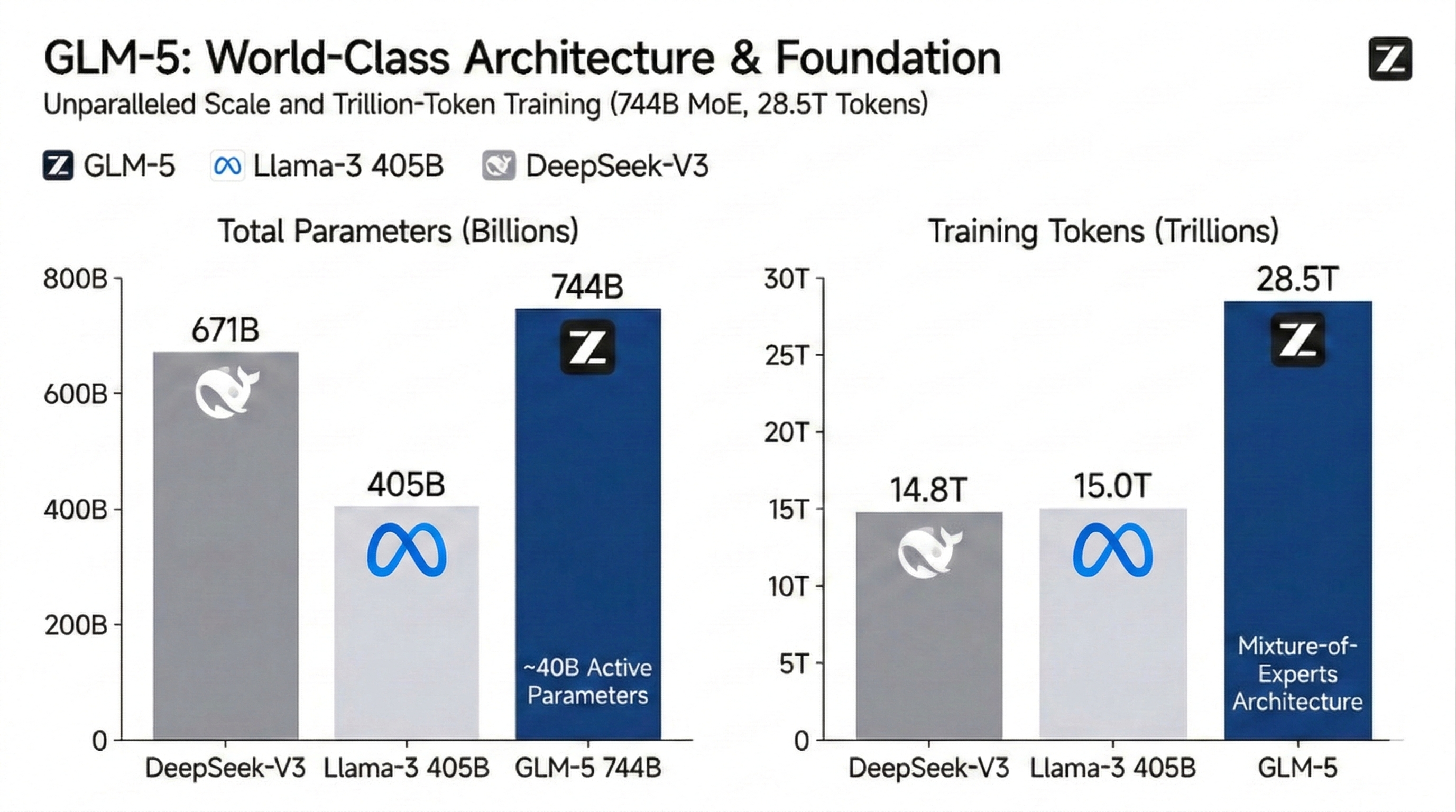
Massive 744B MoE Architecture and Universal Knowledge Base
The GLM-5 model leverages a 744 billion parameter Mixture-of-Experts (MoE) architecture trained on a staggering 28.5 trillion tokens to redefine open-source performance ceilings. By optimizing 40 billion active parameters, it facilitates a massive leap in world knowledge density and retrieval precision. It is the premier foundation for large-scale cognitive tasks and complex data synthesis.
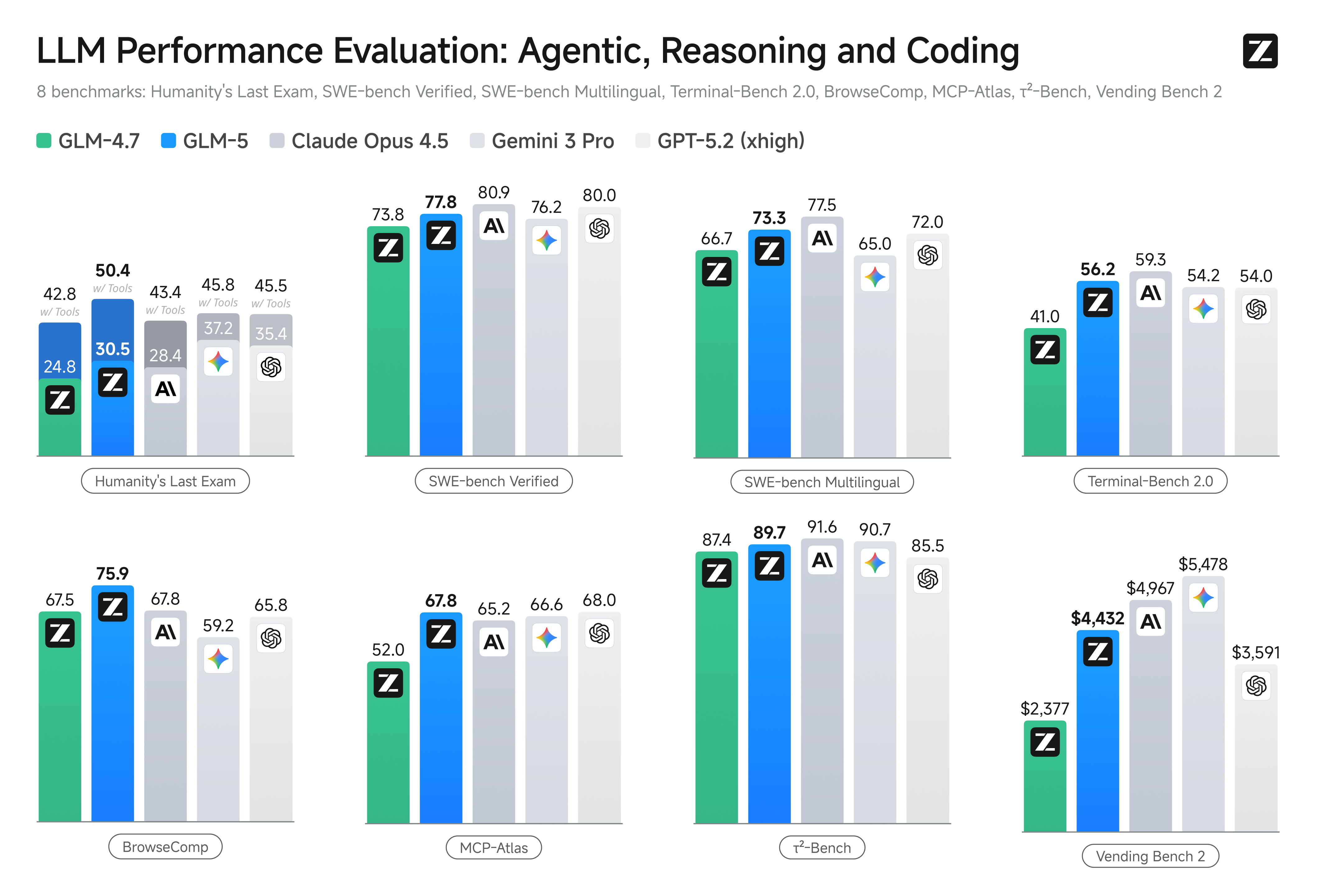
Breakthrough Agentic System Engineering with GLM-5
GLM-5 introduces advanced agentic capabilities designed for long-horizon, systemic task execution across multi-step reasoning environments. By integrating sophisticated planning logic into its core architecture, the model maintains exceptional stability during automated software development and professional legal drafting. It serves as the definitive engine for autonomous workflows requiring extreme precision and long-term consistency.
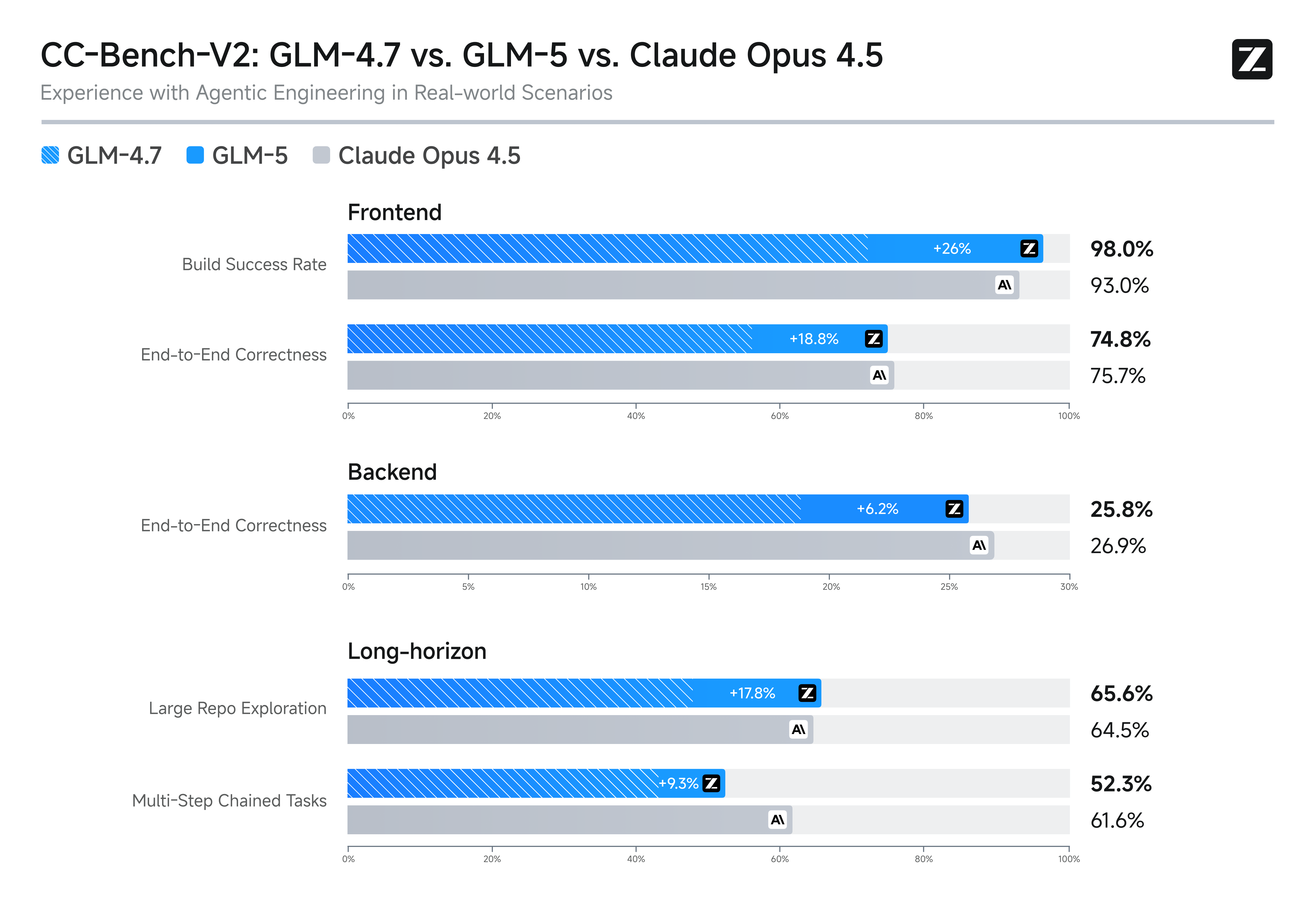
Slime Asynchronous Reinforcement Learning and Logic Evolution
GLM-5 utilizes the innovative "Slime" asynchronous reinforcement learning infrastructure to revolutionize post-training efficiency and logical rigor. This breakthrough significantly enhances code generation quality and algorithmic reasoning, surpassing previous benchmarks and securing its rank as the top-tier open-source model. It is the ultimate solution for full-stack development and high-level structural problem-solving.
What You Can Do with GLM LLM Models
Discover practical use cases and workflows you can build with this model family — from content creation and automation to production-grade applications.
Comprehensive Repository Intelligence with GLM-5
The GLM-5 API empowers developers to ingest entire codebases for deep logic analysis and structural refactoring. By mapping dependency graphs and tracing complex asynchronous data flows, it identifies edge-case race conditions and hidden technical debt. Perfect for rapid team onboarding, automated PR reviews, and maintaining scalable, high-performance microservices architectures.
Instant Full-Stack Prototyping using GLM-5
For vibe-driven development, GLM-5 converts abstract visual mocks and fragmented notes into deployable React or Next.js components. It handles the heavy lifting of boilerplate generation, Tailwind CSS styling, and state management while ensuring cross-page consistency. Ideal for solo founders, UX experimenters, and shipping functional MVPs at lightning speed.
Autonomous Workflow Orchestration with GLM-5
GLM-5 excels at managing long-horizon research tasks that require multi-step reasoning and real-time tool integration. It can independently synthesize multi-source market data, draft compliant legal summaries, and automate complex cross-platform scheduling without losing context. This use case fits project managers, legal professionals, and anyone requiring a high-reliability digital agent for systemic operations.
Model Comparison
See how models from different providers stack up — compare performance, pricing, and unique strengths to make an informed decision.
| Model | Context | Max Output | Input | Positioning |
|---|---|---|---|---|
| GLM-5 | 202.75K | 202.75K | Text | Flagship Foundation Model |
| GLM-4.7 | 202.75K | 202.75K | Text | Flagship Foundation Model |
| GLM-4.6 | 202.75K | 202.75K | Text | Efficient MoE Model |
| DeepSeek V3.2 | 163.84K | 163.84K | Text | Flagship General |
| MiniMax-M2.5 | 204.8K | 196.6K | Text | SOTA Agentic Coding |
How to Use GLM LLM Models on Atlas Cloud
Get started in minutes — follow these simple steps to integrate and deploy models through Atlas Cloud's platform.
Create an Atlas Cloud Account
Sign up at atlascloud.ai and complete verification. New users receive free credits to explore the platform and test models.
Why Use GLM LLM Models on Atlas Cloud
Combining the advanced GLM LLM Models models with Atlas Cloud's GPU-accelerated platform provides unmatched performance, scalability, and developer experience.
Performance & flexibility
Low Latency:
GPU-optimized inference for real-time reasoning.
Unified API:
Run GLM LLM Models, GPT, Gemini, and DeepSeek with one integration.
Transparent Pricing:
Predictable per-token billing with serverless options.
Enterprise & Scale
Developer Experience:
SDKs, analytics, fine-tuning tools, and templates.
Reliability:
99.99% uptime, RBAC, and compliance-ready logging.
Security & Compliance:
SOC 2 Type II, HIPAA alignment, data sovereignty in US.
Frequently Asked Questions about GLM LLM Models
With 28.5T tokens of training data and stellar benchmark results, GLM-5 is widely regarded as the "ceiling of open-source." It rivals or exceeds top-tier global commercial models in capacity and logic, providing a powerful, high-performance foundation for the global developer ecosystem.
HLE is a high-difficulty benchmark designed to test if AI possesses expert-level human knowledge and reasoning. GLM-5 achieving the top score signifies that its mastery of frontier science and complex logic has reached or surpassed the level of leading closed-source models.
BrowseComp is a definitive leaderboard for "Agentic" capabilities, focusing on complex task planning and execution in real-world web environments. The highest score represents GLM-5’s ability to autonomously navigate browsers and integrate cross-page information, marking it as the premier Web Agent engine.
This architecture provides a massive "knowledge base" of 744 billion parameters while activating only ~40B during inference. For developers, this translates to world-class knowledge density and reasoning depth—surpassing dense models like Llama-3 405B—at lower latency and cost.
Total parameters represent the model's "knowledge capacity," with 744B allowing for a vast storage of world facts and expert logic. Active parameters represent the "computational power" used per inference. Thanks to the MoE architecture, GLM-5 delivers 744B-level intelligence using only 40B of compute, balancing a massive knowledge base with high-speed, cost-effective performance.
The volume of pre-training data determines a model's "breadth of vision." 28.5T tokens is one of the largest datasets globally (roughly double that of Llama-3), encompassing rare languages, specialized academic papers, and vast high-quality code. This ensures GLM-5 possesses superior accuracy and generalization when tackling complex long-tail queries, cross-cultural nuances, and low-level system programming.
Explore More Families
Seedance 2.0 Models
Seedance 2.0(by Bytedance) is a multimodal video generation model that redefines "controllable creation," moving beyond the limitations of text or start/end frames. It supports quad-modal inputs—text, image, video, and audio—and introduces an industry-leading "Universal Reference" system. By precisely replicating the composition, camera movement, and character actions from reference assets, Seedance 2.0 solves critical issues with character consistency and physical coherence, empowering creators to act as true "directors" with deep control over their output.

Gemini Omni
Gemini Omni (by Google DeepMind) is a video generation and editing model launched on May 20, 2026 at Google I/O that redefines the standard for "reasoning-driven creation," built specifically to solve the core challenge of AI video: making output that actually understands what you mean, not just what you type. It fuses Gemini's reasoning engine with generative capability, accepting any mix of images, text, video, and audio to produce consistent, knowledge-grounded output. Unlike models that start from scratch each time, Omni lets you edit through natural conversation — swapping objects, rewriting scenes, shifting styles — while keeping physics, characters, and continuity intact across every turn.
Happy Horse 1.0
HappyHorse-1.0 is a unified multimodal AI video generation model that climbed to the top of the Artificial Analysis Video Arena blind-test leaderboard for both text-to-video and image-to-video generation. CNBC Alibaba Group confirmed ownership of HappyHorse, developed under its Alibaba Token Hub (ATH) business unit, where it leads benchmarks outperforming ByteDance's Seedance 2.0 and others. Caixin Global Led by Zhang Di — the former VP of Kuaishou who architected Kling AI — the 15-billion parameter model generates 1080p video with synchronized audio in a single pass using a unified transformer architecture that bypasses the multi-stage pipelines used by every major competitor.
GPT Image 2 Models
GPT Image 2 is a state-of-the-art multimodal foundation model engineered for exceptional text-to-image generation with unprecedented photorealism and creative versatility. Developed by OpenAI as the evolution of the DALL-E lineage, it transforms detailed natural language descriptions into hyper-realistic imagery at up to 4K resolution. With proprietary "Neural Rendering Engine" technology for precise visual control, GPT Image 2 delivers studio-quality results with accurate anatomy, lighting, and composition—making it the premier AI tool for professional creators, enterprises, and developers demanding production-ready visual assets.
Grok-Imagine Models
Grok Imagine Image Quality is xAI's latest AI image generation model, delivering studio-grade visuals with up to 2K resolution and razor-sharp detail. It offers best-in-class text rendering across multiple languages, photorealistic outputs with natural lighting, rich textures, and believable physics, plus tighter prompt following and image editing with reference inputs for precise creative control. Ideal for hero images, ad creatives, product renders, and brand-grade visuals.
Wan2.7 Models
Launching this March, Wan2.7 is the latest powerhouse in the Qwen ecosystem, delivering a massive upgrade in visual fidelity, audio synchronization, and motion consistency over version 2.6. This all-in-one AI video generator supports advanced features like first-and-last frame control, 3x3 grid synthesis, and instruction-based video editing. Outperforming competitors like Jimeng, Wan2.7 offers superior flexibility with support for real-person image inputs, up to five video references, and 1080P high-definition outputs spanning 2 to 15 seconds, making it the premier choice for professional digital storytelling and high-end content marketing.
Veo3.1 Models
Google DeepMind’s Veo 3.1 represents a paradigm shift in AI video generation, empowering creators with director-level narrative control and cinematic-grade audio quality that seamlessly integrates with its enhanced visual realism. By bridging the gap between imaginative concepts and photorealistic execution, this advanced model offers a transformative solution for a wide range of application scenarios, from professional filmmaking and high-end advertising to immersive digital content creation.
ERNIE Image Models
ERNIE-Image is an open-weight text-to-image model developed by the ERNIE-Image Team at Baidu, built on a single-stream Diffusion Transformer (DiT) with 8B parameters and paired with a lightweight Prompt Enhancer that rewrites short prompts into richer, more structured descriptions before passing them to the diffusion backbone. NYU Shanghai RITS Released on April 15, 2026 under the Apache 2.0 license, it transforms natural language descriptions into detailed imagery with particular strength in text rendering and structured layout generation. ERNIE-Image is designed not only for strong visual quality, but for controllability in practical generation scenarios where accurate content realization matters as much as aesthetics — making it well-suited for commercial posters, comics, multi-panel layouts, and other content creation tasks that require both visual quality and precise control.
GPT Image Models
The GPT Image Family is OpenAI's latest suite of multimodal image generation and editing models, built on the powerful GPT architecture. This family includes three tiers — GPT Image-1, GPT Image-1.5, and GPT Image-1 Mini — each available in both Text-to-Image and Image-to-Image variants. Combining GPT's world-class language understanding with DALL·E-class visual synthesis, these models deliver exceptional prompt adherence, photorealistic rendering, and creative versatility across illustration, photography, design, and visualization tasks. The series offers flexible pricing and quality tiers to match any workflow — from rapid prototyping and high-volume content production to professional-grade final deliverables. Whether you need ultra-fast iterations at minimal cost or maximum quality for brand campaigns, the GPT Image Family has a solution tailored to your needs.
Nano Banana2 Models
Nano Banana 2 (by Google), is a generative image model that perfectly balances lightning-fast rendering with exceptional visual quality. With an improved price-performance ratio, it achieves breakthrough micro-detail depiction, accurate native text rendering, and complex physical structure reconstruction. It serves as a highly efficient, commercial-grade visual production tool for developers, marketing teams, and content creators.
Seedream5.0 Models
Seedream 5.0, developed by ByteDance’s Jimeng AI, is a high-performance AI image generation model that integrates real-time search with intelligent reasoning. Purpose-built for time-sensitive content and complex visual logic, it excels at professional infographics, architectural design, and UI assistance. By blending live web insights with creative precision, Seedream 5.0 empowers commercial branding and marketing with a seamless, logic-driven workflow that turns sophisticated data into stunning, high-fidelity visuals.
Kling3.0 Models
Kuaishou’s flagship video generation suite, Kling 3.0, features two powerhouse models—Kling 3.0 (Upgraded from Kling 2.6) and Kling 3.0 Omni (Kling O3, Upgraded from Kling O1)—both offering high-fidelity native audio integration. While Kling 3.0 excels in intelligent cinematic storytelling, multilingual lip-syncing, and precision text rendering, Kling O3 sets a new standard for professional-grade subject consistency by supporting custom subjects and voice clones derived from video or image inputs. Together, these models provide a comprehensive solution tailored for cinematic narratives, global marketing campaigns, social media content, and digital skit production.
Seedance 2.0 Models
Seedance 2.0(by Bytedance) is a multimodal video generation model that redefines "controllable creation," moving beyond the limitations of text or start/end frames. It supports quad-modal inputs—text, image, video, and audio—and introduces an industry-leading "Universal Reference" system. By precisely replicating the composition, camera movement, and character actions from reference assets, Seedance 2.0 solves critical issues with character consistency and physical coherence, empowering creators to act as true "directors" with deep control over their output.
Gemini Omni
Gemini Omni (by Google DeepMind) is a video generation and editing model launched on May 20, 2026 at Google I/O that redefines the standard for "reasoning-driven creation," built specifically to solve the core challenge of AI video: making output that actually understands what you mean, not just what you type. It fuses Gemini's reasoning engine with generative capability, accepting any mix of images, text, video, and audio to produce consistent, knowledge-grounded output. Unlike models that start from scratch each time, Omni lets you edit through natural conversation — swapping objects, rewriting scenes, shifting styles — while keeping physics, characters, and continuity intact across every turn.
Happy Horse 1.0
HappyHorse-1.0 is a unified multimodal AI video generation model that climbed to the top of the Artificial Analysis Video Arena blind-test leaderboard for both text-to-video and image-to-video generation. CNBC Alibaba Group confirmed ownership of HappyHorse, developed under its Alibaba Token Hub (ATH) business unit, where it leads benchmarks outperforming ByteDance's Seedance 2.0 and others. Caixin Global Led by Zhang Di — the former VP of Kuaishou who architected Kling AI — the 15-billion parameter model generates 1080p video with synchronized audio in a single pass using a unified transformer architecture that bypasses the multi-stage pipelines used by every major competitor.
GPT Image 2 Models
GPT Image 2 is a state-of-the-art multimodal foundation model engineered for exceptional text-to-image generation with unprecedented photorealism and creative versatility. Developed by OpenAI as the evolution of the DALL-E lineage, it transforms detailed natural language descriptions into hyper-realistic imagery at up to 4K resolution. With proprietary "Neural Rendering Engine" technology for precise visual control, GPT Image 2 delivers studio-quality results with accurate anatomy, lighting, and composition—making it the premier AI tool for professional creators, enterprises, and developers demanding production-ready visual assets.
Grok-Imagine Models
Grok Imagine Image Quality is xAI's latest AI image generation model, delivering studio-grade visuals with up to 2K resolution and razor-sharp detail. It offers best-in-class text rendering across multiple languages, photorealistic outputs with natural lighting, rich textures, and believable physics, plus tighter prompt following and image editing with reference inputs for precise creative control. Ideal for hero images, ad creatives, product renders, and brand-grade visuals.
Wan2.7 Models
Launching this March, Wan2.7 is the latest powerhouse in the Qwen ecosystem, delivering a massive upgrade in visual fidelity, audio synchronization, and motion consistency over version 2.6. This all-in-one AI video generator supports advanced features like first-and-last frame control, 3x3 grid synthesis, and instruction-based video editing. Outperforming competitors like Jimeng, Wan2.7 offers superior flexibility with support for real-person image inputs, up to five video references, and 1080P high-definition outputs spanning 2 to 15 seconds, making it the premier choice for professional digital storytelling and high-end content marketing.
Veo3.1 Models
Google DeepMind’s Veo 3.1 represents a paradigm shift in AI video generation, empowering creators with director-level narrative control and cinematic-grade audio quality that seamlessly integrates with its enhanced visual realism. By bridging the gap between imaginative concepts and photorealistic execution, this advanced model offers a transformative solution for a wide range of application scenarios, from professional filmmaking and high-end advertising to immersive digital content creation.
ERNIE Image Models
ERNIE-Image is an open-weight text-to-image model developed by the ERNIE-Image Team at Baidu, built on a single-stream Diffusion Transformer (DiT) with 8B parameters and paired with a lightweight Prompt Enhancer that rewrites short prompts into richer, more structured descriptions before passing them to the diffusion backbone. NYU Shanghai RITS Released on April 15, 2026 under the Apache 2.0 license, it transforms natural language descriptions into detailed imagery with particular strength in text rendering and structured layout generation. ERNIE-Image is designed not only for strong visual quality, but for controllability in practical generation scenarios where accurate content realization matters as much as aesthetics — making it well-suited for commercial posters, comics, multi-panel layouts, and other content creation tasks that require both visual quality and precise control.
GPT Image Models
The GPT Image Family is OpenAI's latest suite of multimodal image generation and editing models, built on the powerful GPT architecture. This family includes three tiers — GPT Image-1, GPT Image-1.5, and GPT Image-1 Mini — each available in both Text-to-Image and Image-to-Image variants. Combining GPT's world-class language understanding with DALL·E-class visual synthesis, these models deliver exceptional prompt adherence, photorealistic rendering, and creative versatility across illustration, photography, design, and visualization tasks. The series offers flexible pricing and quality tiers to match any workflow — from rapid prototyping and high-volume content production to professional-grade final deliverables. Whether you need ultra-fast iterations at minimal cost or maximum quality for brand campaigns, the GPT Image Family has a solution tailored to your needs.
Nano Banana2 Models
Nano Banana 2 (by Google), is a generative image model that perfectly balances lightning-fast rendering with exceptional visual quality. With an improved price-performance ratio, it achieves breakthrough micro-detail depiction, accurate native text rendering, and complex physical structure reconstruction. It serves as a highly efficient, commercial-grade visual production tool for developers, marketing teams, and content creators.
Seedream5.0 Models
Seedream 5.0, developed by ByteDance’s Jimeng AI, is a high-performance AI image generation model that integrates real-time search with intelligent reasoning. Purpose-built for time-sensitive content and complex visual logic, it excels at professional infographics, architectural design, and UI assistance. By blending live web insights with creative precision, Seedream 5.0 empowers commercial branding and marketing with a seamless, logic-driven workflow that turns sophisticated data into stunning, high-fidelity visuals.
Kling3.0 Models
Kuaishou’s flagship video generation suite, Kling 3.0, features two powerhouse models—Kling 3.0 (Upgraded from Kling 2.6) and Kling 3.0 Omni (Kling O3, Upgraded from Kling O1)—both offering high-fidelity native audio integration. While Kling 3.0 excels in intelligent cinematic storytelling, multilingual lip-syncing, and precision text rendering, Kling O3 sets a new standard for professional-grade subject consistency by supporting custom subjects and voice clones derived from video or image inputs. Together, these models provide a comprehensive solution tailored for cinematic narratives, global marketing campaigns, social media content, and digital skit production.


