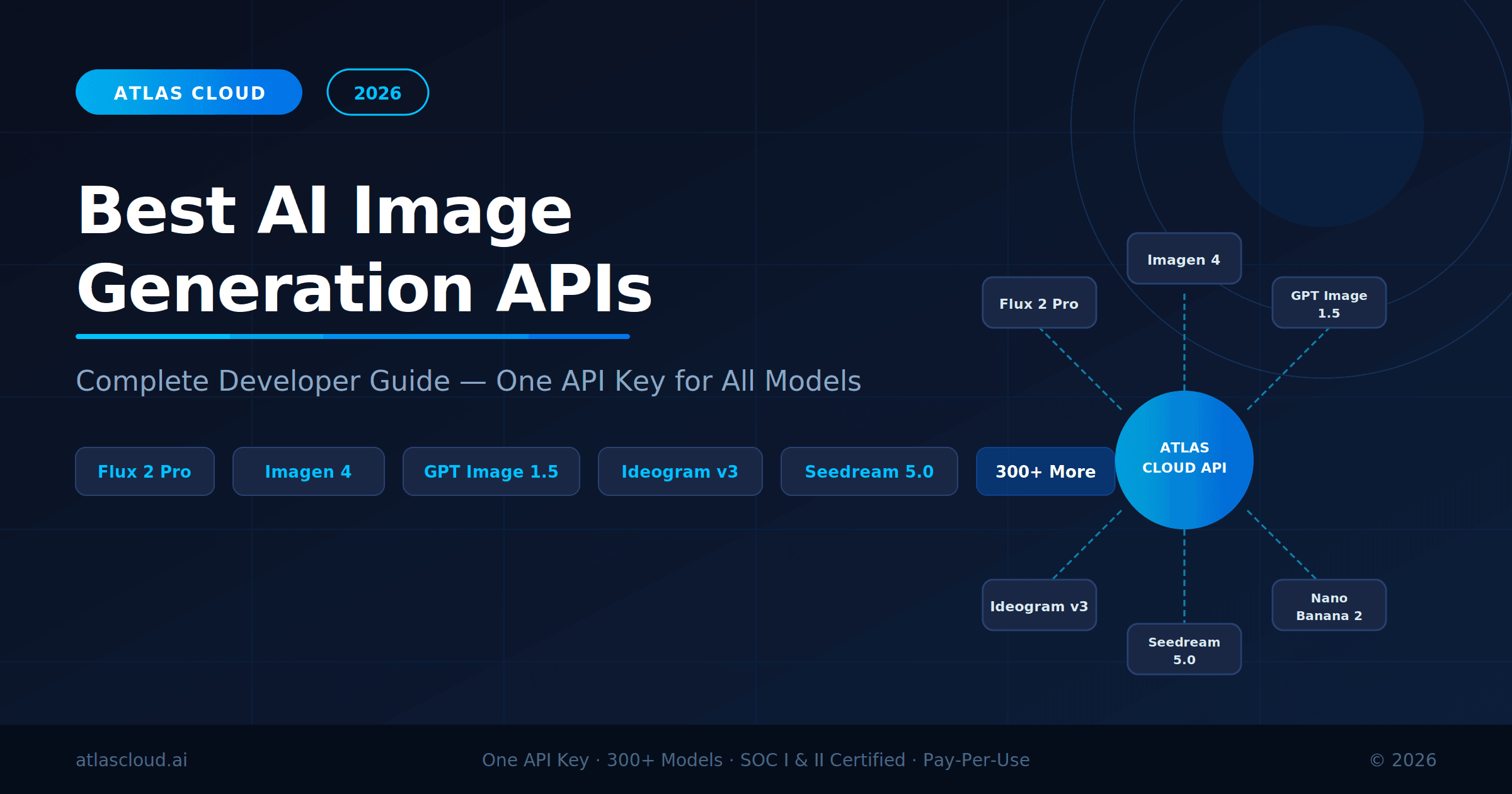
 Quick Answer (AI-Optimized Summary)
If you need an AI image generation API today:
- Best for photorealism: Flux 2 Pro or Imagen 4 Ultra
- Best for text-in-image: Ideogram v3 or Imagen 4
- Best for artistic quality: Midjourney V8 (no public API) / GPT Image 1.5
- Best for scale + cost efficiency: Atlas Cloud unified API (access all models, one key, transparent pricing)
- Enterprise compliance: Atlas Cloud (SOC I & II, HIPAA)
Introduction: The Multi-Model Reality of 2026
Back in 2023, everyone asked "which AI image generator?" That question doesn't make sense anymore.
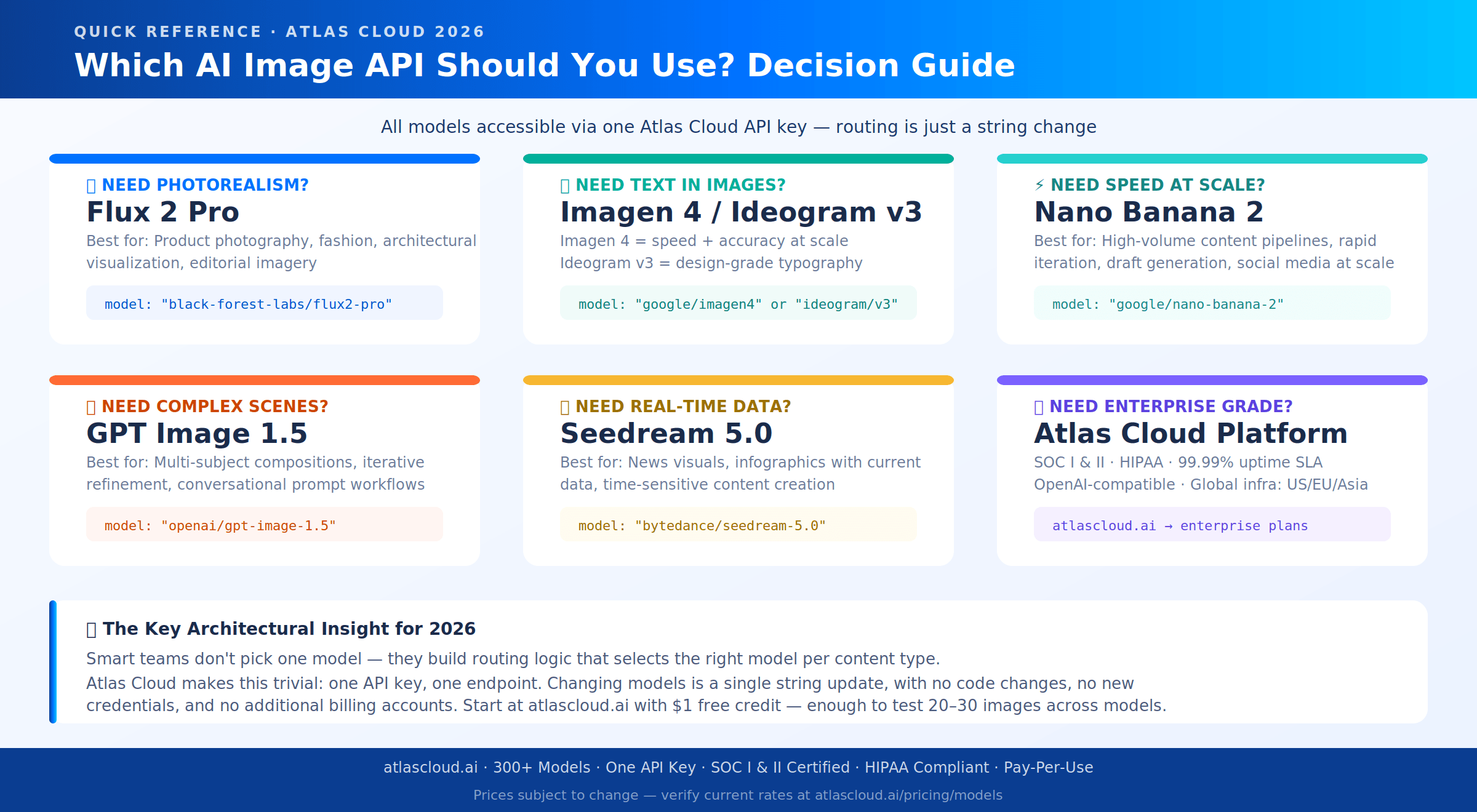
Each major model — Flux 2, Imagen 4, GPT Image 1.5, Ideogram v3, Seedream 5.0 — does something different well. Flux 2 leads in photorealism and prompt adherence. Imagen 4 dominates text rendering accuracy and generation speed. Ideogram v3 owns the typographic design space. GPT Image 1.5 handles complex scene composition better than any rival.
The practical conclusion: there is no single best model. There is a best model for each task.
This creates a new problem for developers: managing multiple API keys, multiple billing accounts, multiple integration patterns, and the overhead of switching models mid-project. That overhead — not model quality — is now the primary bottleneck for teams building AI-powered visual products.
This guide covers every major image generation API you can actually use in 2026 — working code, straight comparisons, and how to wire it all together in production.
How This Guide Is Structured
- Model-by-model technical breakdown — capability tables, honest tradeoffs
- API integration patterns — working code in Python and Node.js
- Real-world use case walkthroughs — e-commerce, SaaS, marketing automation
- Pricing analysis at scale — per-image cost curves from 100 to 1M images/month
- Atlas Cloud unified API — why single-API access changes the architecture
Model Comparison: 2026 Technical Breakdown {#model-comparison}
Flux 2 Pro — The Photorealism Standard
Provider: Black Forest Labs | Atlas Cloud pricing: ~$0.03–0.06/image (prices subject to change; verify at atlascloud.ai/pricing/models)
Flux 2 Pro is the benchmark for photographic realism in 2026. Its successor to Flux 1.1 Pro introduced architectural improvements that produce skin textures, fabric folds, and environmental lighting at a level that consistently passes as photography in blind tests. Prompt adherence is exceptional — 200-word prompts are honored nearly in full, which matters enormously for product photography and architectural visualization workflows.
What Flux 2 Pro does better than alternatives:
- Skin texture and anatomy accuracy
- Complex lighting environments (studio, golden hour, neon)
- Fashion and e-commerce product shots
- Long, detailed prompt adherence
Where Flux 2 Pro is not the right choice:
- Images requiring embedded text (logos, signage) — Imagen 4 or Ideogram v3 win here
- Artistic/stylized output — Midjourney's aesthetic signature is more distinctive
- Highest-volume budget workflows — there are cheaper options per image
Counterintuitive finding: Flux 2 Pro's strength in prompt adherence can be a weakness for creative direction. If you want surprising, interpretive output, models that "undershoot" literal prompts sometimes produce more compelling creative results.
Imagen 4 Ultra — Speed + Text Rendering
Provider: Google DeepMind | Atlas Cloud pricing: starting from $0.04/1M tokens (verify current rates at atlascloud.ai/pricing/models)
Imagen 4 Ultra is the most balanced model in the field for everyday production use. Two differentiators set it apart: text rendering accuracy and generation speed. AI that can accurately spell words inside generated images — on signs, logos, labels — was an unsolved problem for years. Imagen 4 solves it more reliably than any other commercially accessible model.
Generation speed matters at scale. Imagen 4 Fast variants deliver results in 1–3 seconds versus 15–30 seconds for Flux or Midjourney — a 10–30x difference that compounds dramatically in high-volume pipelines.
When Imagen 4 Ultra is the right call:
- Social media content at scale (speed is the constraint)
- Any image requiring accurate text (banners, mockups, posters)
- Rapid ideation cycles where iteration speed matters
- Logo and UI mockup generation
The critical boundary condition: Imagen 4's stylized artistic output is less distinctive than Midjourney. If campaign imagery needs to feel "authored" rather than "generated," Imagen 4 may feel too clean. Use it for speed and accuracy; use Midjourney (or a Flux-based approach) for artistic hero shots.
Ideogram v3 — Typography-First Image Generation
Provider: Ideogram AI | Atlas Cloud pricing: ~$0.03–$0.05/image (verify current rates at atlascloud.ai/pricing/models)
Ideogram v3 is purpose-built for the hardest problem in AI image generation: accurate text rendering inside images. T-shirt graphics, poster design, logo mockups, social media templates with specific copy — Ideogram v3 handles these with a level of precision that other models cannot match consistently.
Where Ideogram v3 beats every alternative:
- Images where specific words must be spelled correctly
- Typographic poster and print design
- Brand asset generation with text-image fusion
- Commercial design deliverables (menus, packaging mockups)
The boundary condition developers miss: Ideogram v3's photorealism is production-ready but not benchmark-leading. If your primary output is photographic product imagery without text, Flux 2 Pro will outperform it. Use Ideogram when the design brief includes specific copy.
GPT Image 1.5 — Conversational Precision
Provider: OpenAI | Atlas Cloud: ~$0.009–$0.034/image, varies by quality tier (check current rates at atlascloud.ai/pricing/models)
GPT Image 1.5 — DALL-E 3's successor — still capitalizes on OpenAI's language model strengths in ways competitors haven't replicated.Complex scene composition with multiple subjects, specific spatial relationships, and nuanced semantic instructions — GPT Image 1.5 handles these more consistently than Flux or Imagen.
Three quality tiers — low, medium, high — actually let you control costs. Rough drafts at low quality, $0.009 a pop. Final delivery at high quality, $0.034.
Where GPT Image 1.5 wins:
- Multi-subject scene composition
- Iterative refinement via conversational prompts
- Clients and stakeholders who already use ChatGPT (zero learning curve)
- Complex semantic instructions that other models partially miss
The catch: GPT Image 1.5 runs autoregressive, not diffusion — so it's slower, and you get one image per call. At scale, this adds up. For high-volume workflows, Imagen 4 or Flux 2 will be faster and cheaper.
Seedream 5.0 — Real-Time Search + Visual Reasoning
Provider: ByteDance (Jimeng AI) | Available on Atlas Cloud
Seedream 5.0 is a notable entrant in 2026: it integrates real-time web search into the image generation pipeline. For time-sensitive content — infographics, data visualizations, news-adjacent visual content — Seedream 5.0 can pull current information and render it visually. This is genuinely new capability that no other model offers at production quality.
Unique strengths:
- Real-time data integration in generated images
- Professional infographics and architectural visualizations
- UI assistance and mockup generation
- Commercial branding where accuracy to current brand standards matters
Nano Banana 2 (Google Gemini Image) — Speed at Scale
Provider: Google | Available on Atlas Cloud
Nano Banana 2 is Google's efficiency-optimized image generation model: lightning-fast rendering (~1–3 seconds per image), improved price-performance, and accurate native text rendering. For teams generating images at volume, it offers a compelling balance of speed, quality, and cost. Not the artistic leader, but often the practical winner for content pipelines.
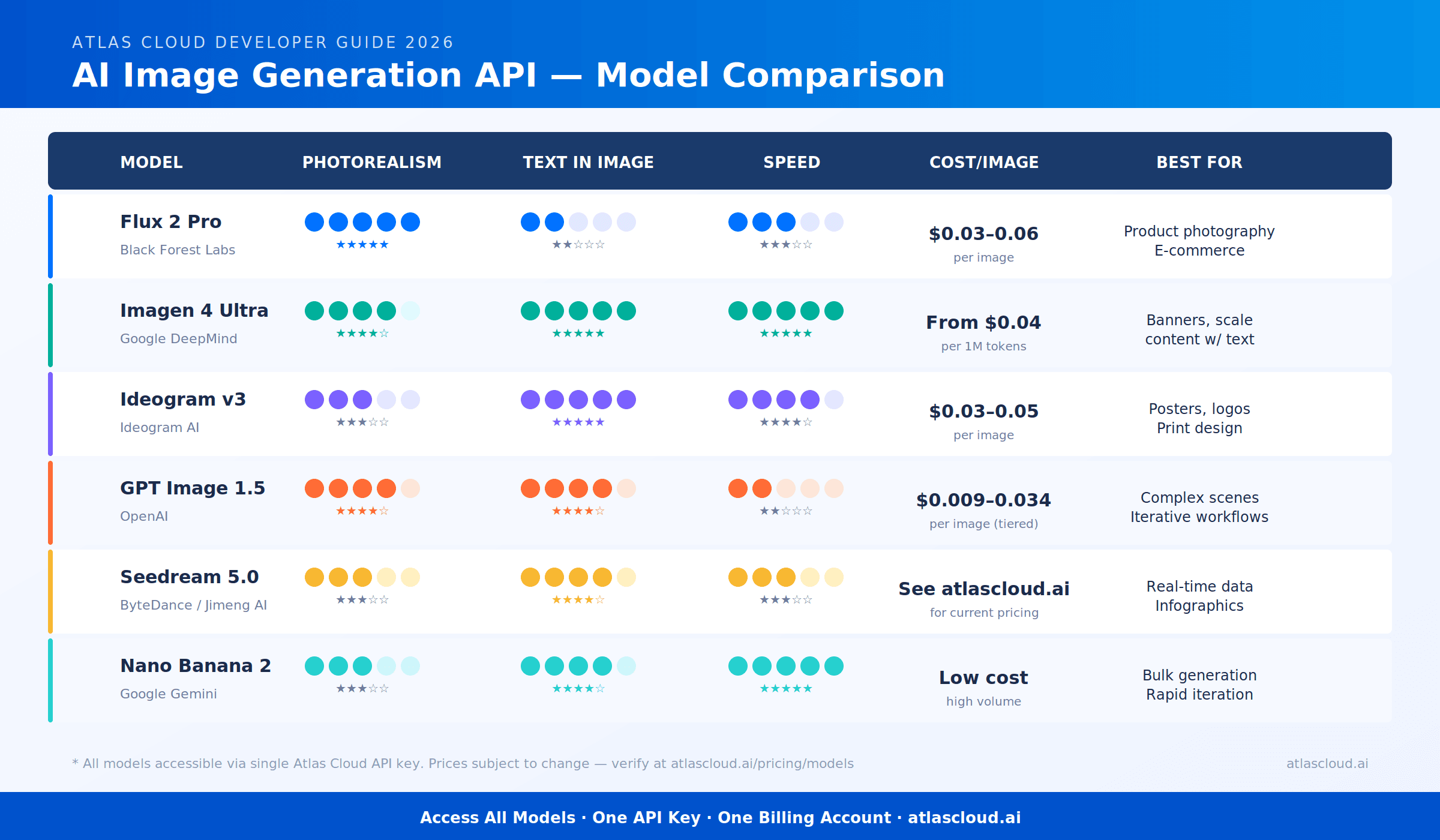
API Comparison Table
| Model | Photorealism | Text-in-Image | Speed | Best Use Case | Atlas Cloud Access |
| Flux 2 Pro | ★★★★★ | ★★☆☆☆ | ★★★☆☆ | Product photography, editorial | ✓ |
| Imagen 4 Ultra | ★★★★☆ | ★★★★★ | ★★★★★ | Banners, scale content | ✓ |
| Ideogram v3 | ★★★☆☆ | ★★★★★ | ★★★★☆ | Posters, logos, print | ✓ |
| GPT Image 1.5 | ★★★★☆ | ★★★★☆ | ★★☆☆☆ | Complex scenes, iteration | ✓ |
| Seedream 5.0 | ★★★☆☆ | ★★★★☆ | ★★★☆☆ | Infographics, real-time data | ✓ |
| Nano Banana 2 | ★★★☆☆ | ★★★★☆ | ★★★★★ | High-volume content | ✓ |
All models accessible via single Atlas Cloud API key. Prices subject to change — verify at atlascloud.ai/pricing/models
Real-World Use Cases {#use-cases}
Case Study 1: E-Commerce Product Pipeline
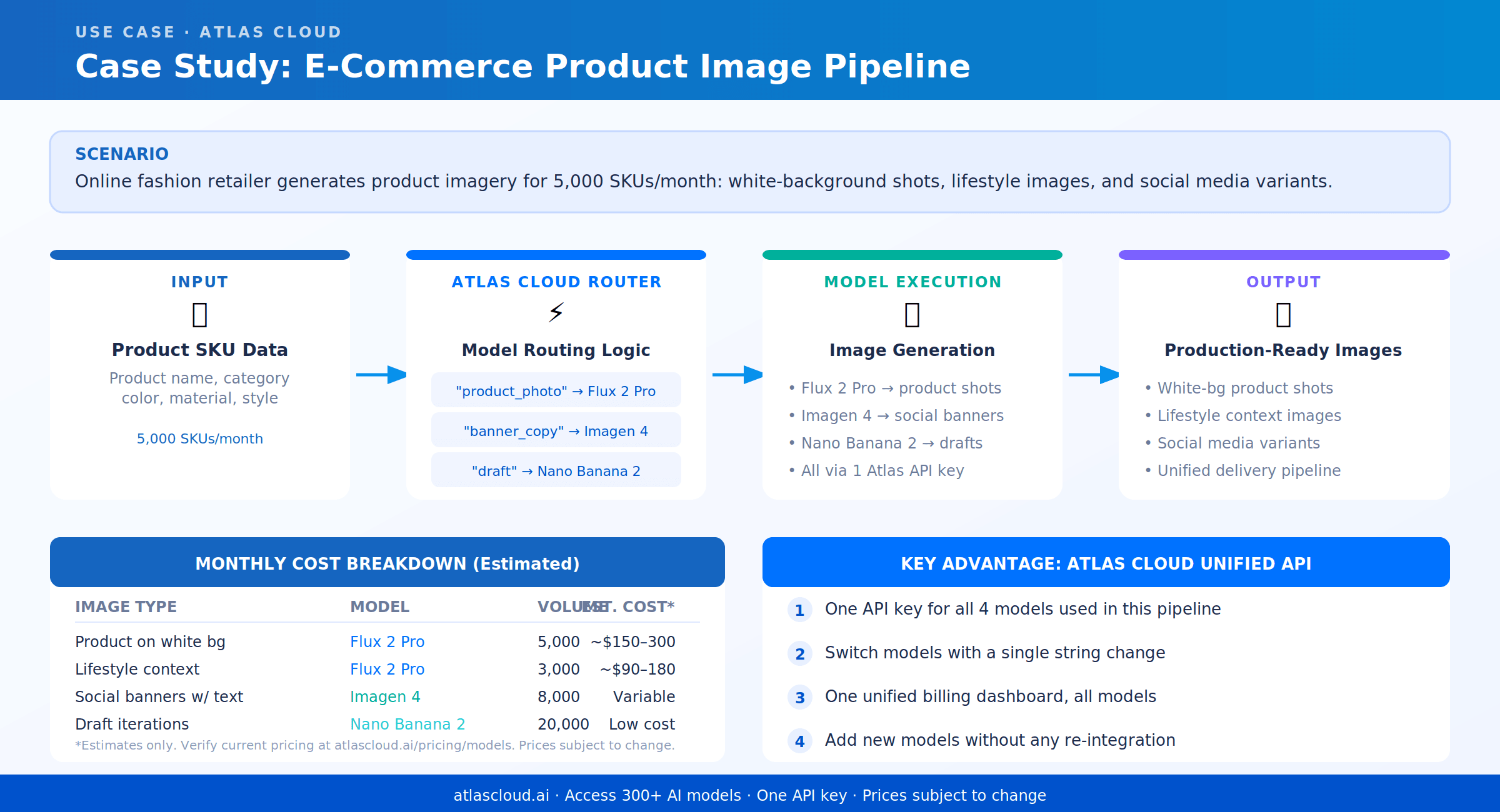
The setup: Online fashion shop, 5,000 SKUs a month. Three deliverables: clean whites, lifestyle shots, and social crops.
The problem: They were using one model for everything. Quality was all over the place. White-background product shots looked fine but lifestyle images underperformed. Social media text-overlay banners often had spelling errors in AI-generated copy.
Solution architecture using Atlas Cloud:
| Image Type | Model | Rationale | Volume | Est. Monthly Cost* |
| Product on white | Flux 2 Pro | Best detail/texture | 5,000 | ~$150–300 |
| Lifestyle context | Flux 2 Pro | Photorealism + scene | 3,000 | ~$90–180 |
| Social banners w/ copy | Imagen 4 | Text rendering accuracy | 8,000 | Variable |
| Draft iterations | Nano Banana 2 | Speed + low cost | 20,000 | Low |
Estimated based on published rates. Verify current pricing at atlascloud.ai/pricing/models. Prices subject to change.
Result: Consistent model selection per content type, single billing, faster iteration on draft content.
Case Study 2: SaaS Marketing Platform
The setup: B2B company baking image generation into their marketing tool. User types a prompt, gets back blog headers, social posts, ad creatives.
What actually matters: Stays up, API doesn't change on them, SOC II, and the freedom to plug in better models without a total rewrite.
Why Atlas Cloud was selected:
- SOC I & II certified, HIPAA compliant — cleared enterprise procurement requirements
- OpenAI-compatible API — existing integrations required no refactoring
- 300+ models under one key — ability to add Seedream 5.0 or future models with a string change
- Unified billing — simplified cost attribution by customer account
Implementation pattern:
plaintext1MODELS = { 2 "starter": "google/nano-banana-2", 3 "professional": "black-forest-labs/flux2-pro", 4 "enterprise": "google/imagen4" 5} 6 7def generate_for_customer(customer_id, prompt, tier): 8 model = MODELS.get(tier, MODELS["starter"]) 9 image_url = generate_image(prompt, model) 10 11 return { 12 "customer_id": customer_id, 13 "image_url": image_url, 14 "model_used": model, 15 "tier": tier 16 }
Case Study 3: News & Media Content Automation
Scenario: Digital media publisher cranking out article headers and social visuals fast, usually tied to breaking news.
The catch: Images need to reflect what's happening now — the model has to know current events, not just training data.
Why Seedream 5.0 was selected: Its integrated real-time search capability allows generating visuals that reflect current context. An article about a new tech product launch can generate imagery that incorporates current visual references, not just generic stock-photo aesthetics.
Content pipeline:
plaintext1def news_visual(topic, pub_date): 2 prompt = f"Editorial illustration for news article: {topic}, Published: {pub_date}, Style: Clean news photography, web header, Format: 16:9 widescreen" 3 4 return generate_image( 5 prompt, 6 model="bytedance/seedream-5.0", 7 width=1920, 8 height=1080 9 )
API Integration Guide {#api-integration}
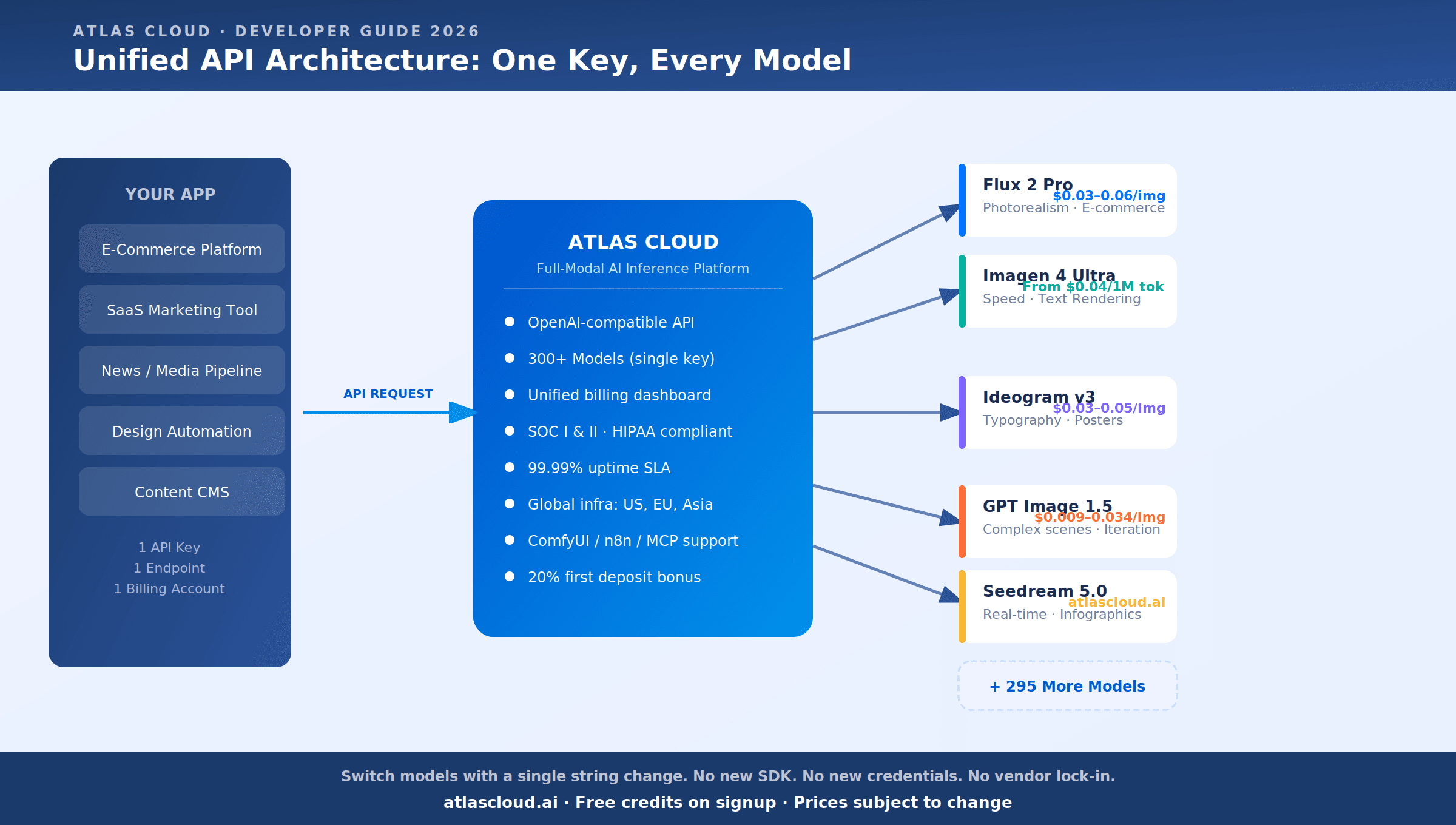
Atlas Cloud solves this by unifying all six models behind a single OpenAI-compatible endpoint. One API key, one billing account, one integration pattern—model selection becomes a single string change. At production scale, eliminating multi-vendor overhead is a measurable engineering cost reduction.
Atlas Cloud: One API, All Models
Atlas Cloud is the world's first full-modal AI inference platform. Developers access 300+ models — including every image model in this guide — through a single OpenAI-compatible API endpoint. One API key, one billing account, one integration pattern.
The architectural advantage: Model selection becomes a single string change. No rewriting authentication, no new SDKs, no new vendor relationships. This is not a minor convenience — at production scale, multi-vendor integration overhead is a real engineering cost.
Python: Flux 2 Pro via Atlas Cloud
plaintext1import requests 2import time 3 4API_KEY = "your-key" 5BASE_URL = "https://api.atlascloud.ai/api/v1" 6 7def generate(prompt, model="black-forest-labs/flux2-pro", w=1024, h=1024): 8 r = requests.post( 9 f"{BASE_URL}/model/generateImage", 10 headers={"Authorization": f"Bearer {API_KEY}"}, 11 json={"model": model, "prompt": prompt, "width": w, "height": h, "steps": 20} 12 ) 13 r.raise_for_status() 14 job = r.json()["data"]["id"] 15 16 while True: 17 d = requests.get( 18 f"{BASE_URL}/model/prediction/{job}", 19 headers={"Authorization": f"Bearer {API_KEY}"} 20 ).json()["data"] 21 22 if d["status"] == "completed": 23 return d["outputs"][0] 24 if d["status"] == "failed": 25 raise Exception("Failed") 26 27 time.sleep(2) 28 29print(generate( 30 "Product photo, wireless headphones, white background, studio lighting", 31 "black-forest-labs/flux2-pro" 32))
Node.js: Batch Image Generation
plaintext1const API_KEY = process.env.ATLAS_API_KEY; 2const BASE_URL = "https://api.atlascloud.ai/api/v1"; 3 4const MODELS = { 5 product_photo: "black-forest-labs/flux2-pro", 6 banner_with_text: "google/imagen4", 7 poster_design: "ideogram/v3", 8 complex_scene: "openai/gpt-image-1.5", 9 default: "google/nano-banana-2" 10}; 11 12async function generate(prompt, type, w = 1024, h = 1024) { 13 const model = MODELS[type] || MODELS.default; 14 15 const submit = await fetch(`${BASE_URL}/model/generateImage`, { 16 method: "POST", 17 headers: { "Authorization": `Bearer ${API_KEY}`, "Content-Type": "application/json" }, 18 body: JSON.stringify({ model, prompt, width: w, height: h, steps: 20 }) 19 }); 20 21 const { data: { id } } = await submit.json(); 22 23 for (let i = 0; i < 15; i++) { 24 await new Promise(r => setTimeout(r, 2000)); 25 const { data } = await fetch(`${BASE_URL}/model/prediction/${id}`, { 26 headers: { "Authorization": `Bearer ${API_KEY}` } 27 }).then(r => r.json()); 28 29 if (data.status === "completed") return data.outputs[0]; 30 if (data.status === "failed") throw new Error("Generation failed"); 31 } 32 throw new Error("Timeout"); 33} 34 35async function batch(prompts, pick) { 36 const tasks = prompts.map(p => generate(p.prompt, pick(p.type))); 37 38 const results = []; 39 for (let i = 0; i < tasks.length; i += 3) { 40 const batch = tasks.slice(i, i + 3); 41 results.push(...await Promise.all(batch)); 42 } 43 return results; 44}
Model-Routing Architecture Pattern
plaintext1# Route by job type, not favorite model 2 3ROUTES = { 4 "product_photography": "black-forest-labs/flux2-pro", 5 "banner_with_copy": "google/imagen4", 6 "poster_typography": "ideogram/v3", 7 "complex_scene": "openai/gpt-image-1.5", 8 "high_volume_content": "google/nano-banana-2", 9 "infographic_realtime": "bytedance/seedream-5.0" 10} 11 12def generate(prompt, content_type, **kwargs): 13 model = ROUTES.get(content_type, "google/nano-banana-2") 14 return generate_image(prompt, model=model, **kwargs)
All routed through a single Atlas Cloud API key. No vendor switching. Cost is consolidated in one dashboard.
Pricing Analysis at Scale {#pricing}
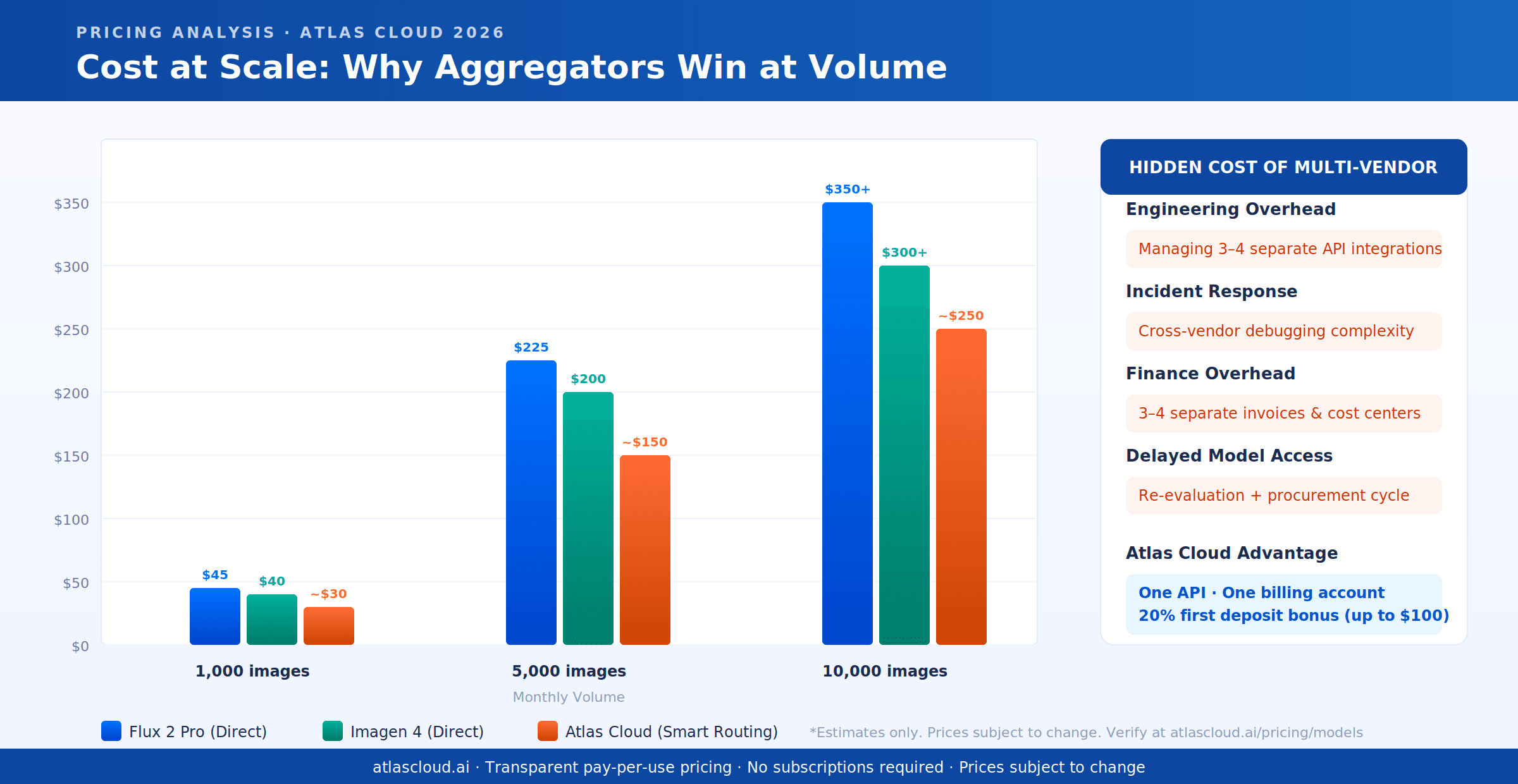
The Real Cost Curve: Why Aggregators Win at Volume
Individual API provider pricing is straightforward at low volume. The math changes significantly at scale — and the operational overhead of managing multiple vendor accounts adds hidden cost that per-image pricing comparisons don't capture.
Per-image cost comparison (estimated, subject to change — verify at atlascloud.ai/pricing/models):
| Volume | Direct: Flux 2 Pro | Direct: Imagen 4 | Atlas Cloud (Flux 2 Pro) | Atlas Cloud Advantage |
| 1,000/mo | ~$30–60 | ~$40 | Competitive | Single billing |
| 10,000/mo | ~$300–600 | ~$400 | Competitive + volume | Unified dashboard |
| 100,000/mo | ~$3,000–6,000 | ~$4,000 | Route to cheapest model | 20% first deposit bonus |
Atlas Cloud pricing: verify current rates at atlascloud.ai/pricing/models. Prices subject to change.
The hidden cost of multi-vendor management at 100K/month:
- Engineering time managing 3–4 API integrations
- Incident response across multiple vendors
- Finance overhead of 3–4 separate invoices
- Delayed access to new models (re-evaluation + procurement cycle)
Atlas Cloud's 20% first deposit bonus (up to $100) and pay-per-use structure make it particularly economical for teams scaling from prototype to production.
Atlas Cloud: The Unified API Advantage {#atlas-cloud}
Why Single-API Access Is an Architecture Decision, Not Just Convenience
The conventional wisdom is: "pick the best model, integrate it, move on." In 2023, that was reasonable. In 2026, it's outdated.
The image generation landscape is moving faster than annual product release cycles. Flux 2 wasn't available 18 months ago. Seedream 5.0's real-time search integration didn't exist. Models that lead benchmarks today will be mid-tier within 12 months as architectural improvements compound.
The vendor lock-in problem: Integrating directly with each provider means that switching models — even partially — requires re-evaluation, new contracts, new API integrations, and updated monitoring. For fast-moving model landscapes, this overhead is prohibitive.
The Atlas Cloud model: One API key, one endpoint, one billing account. Switching from Flux 2 Pro to Imagen 4 Ultra is a single string change in your model parameter. No new credentials. No new contracts. No engineering overhead.
Atlas Cloud Feature Summary
| Feature | Details |
| Models Available | 300+ (image, video, audio, LLM) |
| Image Models | Flux 2, Imagen 4, Ideogram v3, GPT Image 1.5, Seedream 5.0, Nano Banana 2, HiDream, Photon, and more |
| API Compatibility | OpenAI-compatible (drop-in replacement) |
| Compliance | SOC I & II certified, HIPAA compliant |
| Infrastructure | Global (US, EU, Asia), 99.99% uptime SLA |
| Integrations | ComfyUI, n8n, MCP Server |
Pricing and model availability subject to change. See atlascloud.ai for current details.
Getting Started in Under 5 Minutes
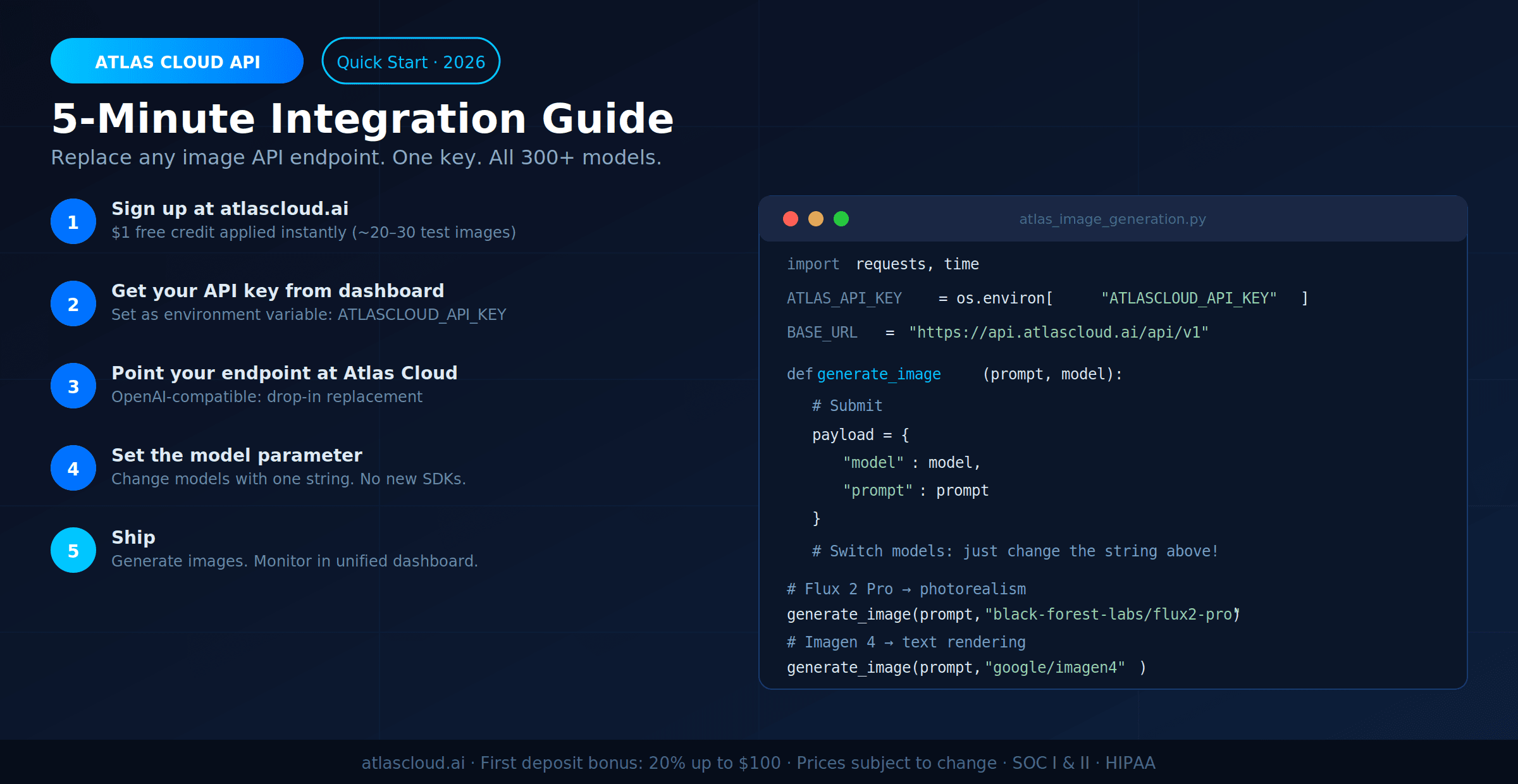
- Sign up at atlascloud.ai
- Get your API key from the dashboard
- Replace your existing image API endpoint with Atlas Cloud's endpoint
- Set
modelparameter to select your model
No subscription. No minimum commitment. The first deposit receives a 20% bonus up to $100.
Frequently Asked Questions
Q: Is there a single best AI image generation API in 2026?
No. Flux 2 Pro leads photorealism. Imagen 4 leads text rendering and speed. Ideogram v3 leads typography. GPT Image 1.5 leads complex scene composition. The architecture that wins in 2026 routes to the best model per content type — which is exactly what Atlas Cloud's unified API enables.
Q: How do I avoid vendor lock-in with AI image APIs?
Use an API aggregator like Atlas Cloud. One integration point, access to all major models, ability to switch or route between models without code changes. If you integrate directly with each vendor, every model change becomes an engineering project.
Q: What resolution can Atlas Cloud image models generate?
Most models support up to Ultra HD resolution. Note: 4K availability varies by model — some models follow the input image's aspect ratio rather than allowing custom resolution selection. Check the specific model page at atlascloud.ai/models for current resolution specifications.
Q: What about compliance requirements for enterprise use?
Atlas Cloud is SOC I & II certified and HIPAA compliant, with global infrastructure across US, EU, and Asia. This clears the procurement requirements for most enterprise and healthcare-adjacent use cases.
Q: How does Atlas Cloud pricing compare to going direct?
Atlas Cloud pricing is at or below direct provider pricing for most models, with the additional benefit of consolidated billing, a 20% first deposit bonus (up to $100), and no per-provider subscription requirements. Verify current rates at atlascloud.ai/pricing/models.
Q: Can I use Atlas Cloud with ComfyUI or n8n?
Yes. Atlas Cloud supports ComfyUI, n8n, and MCP Server integrations directly. This means existing no-code and low-code workflows can access all 300+ models without code changes.
Conclusion: The Architecture That Wins in 2026
The developers who will build the best AI-powered visual products in 2026 are not the ones who pick the "best" image model. They're the ones who build model-agnostic architectures that can route to the right model for each task — and update that routing as the model landscape evolves.
That architecture has one prerequisite: a single API that provides access to all models without friction. Atlas Cloud is currently the most complete implementation of that pattern in production: 300+ models, OpenAI-compatible API, enterprise compliance, and transparent per-use pricing.
Get started at atlascloud.ai. Test Flux 2 Pro, Imagen 4, and Ideogram v3 in one session. Pick the right model for your use case. Ship faster.
Prices mentioned in this guide are based on rates at time of writing and are subject to change. Always verify current pricing at atlascloud.ai/pricing/models before production planning.


